Ball Mills
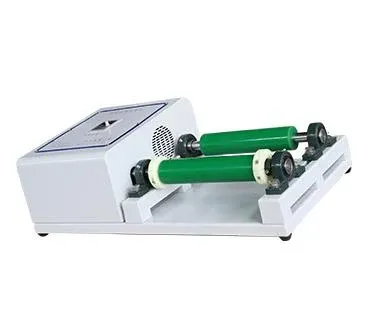
Roller Ball Mill, GQM Series
GQM series roller ball mills (jar mills) for laboratory and small-batch grinding and mixing: single, two and four station models, roller speed 60–570 rpm on single-station models, jar loads up to 80 kg, timer 0–999 min.
Specifications
- Series
- GQM roller ball mills (jar mills)
- Models
- GQM-1-5L, GQM-1-15L (single station); two and four station models available
- Roller Speed
- 60–570 rpm (single-station models), stepless frequency regulation
- Max Load Per Jar
- 35 kg (GQM-1-5L); 80 kg (GQM-1-15L)
- Power
- 0.37 kW (GQM-1-5L); 0.75 kW (GQM-1-15L)
- Timer
- 0–999 min
- Sample Loading
- Up to 2/3 of jar volume
- Feed Size
- ≤10 mm
- Jar Materials
- Agate, Zirconia, Alumina, Tungsten carbide, Stainless steel, PU, PTFE, Nylon; vacuum jars available
- Power Supply
- 110V/220V, 50/60Hz
The simplest mill in the building, and often the right one
Not every grinding job needs high energy. Long, gentle grinding and thorough mixing — ceramic glazes, electronic pastes, metal powders, pigment blends — reward patience and uniformity more than impact. The roller ball mill, or jar mill, does that work with the simplest mechanism in milling: jars rest on driven rollers, the rollers turn, and the media inside cascade steadily for as long as the process needs.
The GQM series covers single-station machines for one jar and two and four station models for parallel work, in laboratory and small-batch sizes.
Steady motion, uniform results
On the single-station models, roller speed adjusts steplessly from 60 to 570 rpm by frequency regulation, so the cascade inside the jar can be set from a gentle roll for mixing to a faster regime for grinding. A timer runs from 0 to 999 minutes, which suits the way roller mills are actually used: load the jar, set the run, and let unattended hours do the work.
Jar loads reach 35 kg on the GQM-1-5L and 80 kg on the GQM-1-15L, with sample loading up to two-thirds of the jar volume. Feed size is up to 10 mm, and output can reach the 50–1000 mesh range depending on material and time.
Any jar your process already uses
A roller mill's flexibility lives in its jars, and the GQM accepts the full material range: agate, zirconia, alumina ceramic, tungsten carbide, stainless steel, polyurethane, PTFE and nylon, with vacuum jars available for air-sensitive material. Roller spacing adjusts to the jar diameter within the machine's range, so a lab that already owns jars for a specific process does not have to abandon them to change the machine.
Media follow the same logic: zirconia balls for low-contamination work, alumina, agate, tungsten carbide or steel for their respective duties, in sizes from 1 mm to 30 mm.
Where roller mills earn their place
Electronic materials and magnetic powders, ceramic glaze and pigment preparation, non-metallic minerals, biomedicine and new-materials research all run roller mills because the process is forgiving, the particle size comes out uniform, and the machine asks for almost nothing in return: compact structure, easy operation, minimal maintenance. For teaching and testing laboratories it is usually the first mill that makes sense; for production support labs it is often the one that stays.
Choosing your station count
One station serves one process at a time. Two and four station models run several jars in parallel — different materials, or the same material at different times — and are the economical way to raise throughput without raising energy per batch. Send us your jar size, batch weight and how many processes run side by side, and we will recommend the model and station count, with jars and media configured to your material.