Grinding Media
Zirconia Grinding Balls, 95% ZrO2 High Density
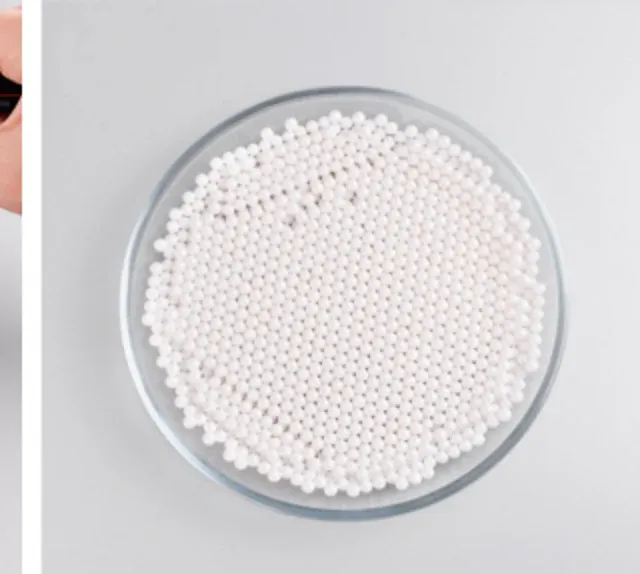
Yttria-stabilized zirconia grinding balls with 94.6% ZrO2, true density ≥6.03 g/cm³, Mohs hardness 9 and sphericity ≥98%. Built for low-contamination wet and dry milling of battery materials, electronic ceramics, coatings and fine powders. Sizes from 0.1 mm, packed in 25 kg drums.
Specifications
- ZrO2 Content
- 94.6%
- Stabilizer
- Y2O3 (5.4% with others)
- True Density
- ≥6.03 g/cm³
- Bulk Density
- ≥3.76 g/cm³
- Mohs Hardness
- 9
- Vickers Hardness
- ≥1210
- Fracture Toughness
- 9 MPa·m1/2
- Grain Size
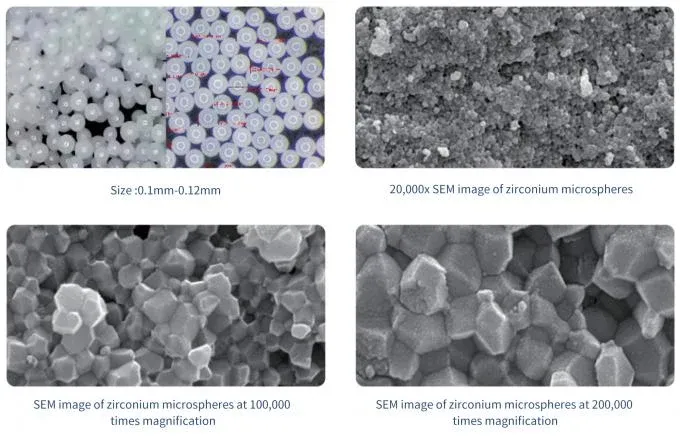
- ≤0.3 µm
- Sphericity
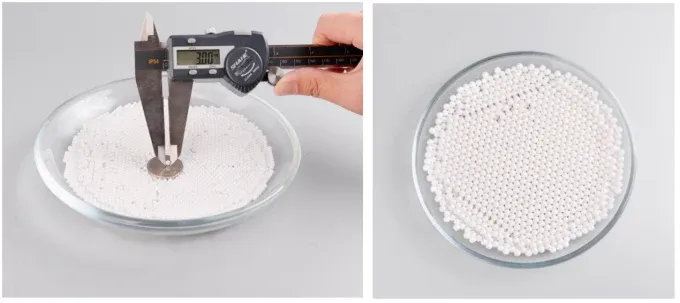
- ≥98%
- Sizes
- From 0.1 mm (0.1 mm grade D50 ≈ 103.2 µm; 0.3 mm grade D50 ≈ 300.1 µm)
- Sintering Temperature
- ≥1500 °C
- Packaging
- 25 kg plastic drum; 800–1000 kg per pallet
Grinding media that protects your powder purity
When the powder is the product — a battery cathode, an electronic ceramic, a pigment or a nano dispersion — the grinding media is not a consumable you buy on price alone. Every hour of milling, the media touches your material millions of times. If it wears fast or sheds contamination, you pay twice: once in media consumption, and again in off-spec batches.
These zirconia grinding balls are made from yttria-stabilized zirconia (Y-TZP) with 94.6% ZrO2, sintered at 1500 °C or above. The result is a dense, fine-grained ball with a true density of at least 6.03 g/cm³, Mohs hardness 9 and sphericity of at least 98%.
Why density and hardness decide your milling cost
Density is energy. A heavier ball carries more kinetic energy into every impact, so high-density zirconia media grinds faster and reaches target fineness in fewer passes than lighter ceramic media. That shortens milling time per batch and lowers the energy spent per kilogram of finished powder.
Hardness is service life. At Mohs 9 with fracture toughness of 9 MPa·m1/2, these balls resist chipping and abrasive wear in both wet and dry milling. Less wear means the media charge keeps its size distribution longer, your particle size results stay stable from batch to batch, and the media cost per tonne of product falls.
Sphericity is consistency. With sphericity of at least 98% and a fine grain size of 0.3 µm or below, the balls roll and cascade evenly instead of sliding and gouging. Your mill runs smoother, and the ground powder sees uniform treatment rather than hot spots of over-grinding.
Built for low-contamination work
Zirconia is chemically stable against strong acids, alkalis and solvents, and the media itself introduces no metallic contamination. That is why these balls are specified where iron pickup is a defect, not a detail: lithium battery materials, electronic ceramics, advanced and traditional ceramics, biological materials, cosmetics and nano-scale powders.
Sizes and packaging
Sizes start at 0.1 mm for fine and nano grinding — the 0.1 mm grade has a D50 of about 103.2 µm, and the 0.3 mm grade a D50 of about 300.1 µm — and run up through the standard milling sizes. If you are replacing an existing media charge, tell us your mill type and current media size; we will match the grade to your target fineness instead of selling you a generic size.
Standard packaging is 25 kg plastic drums, with 800–1000 kg per pallet for bulk orders.
Tell us your milling job
Send us four things — your material, your mill type, your target particle size and your current media — and we will come back with a recommended size, grade and charge ratio for your process. No catalogue guessing, no obligation to order.