Grinding Media
Zirconia Grinding Beads, 0.1 mm / 0.3 mm Micro Beads
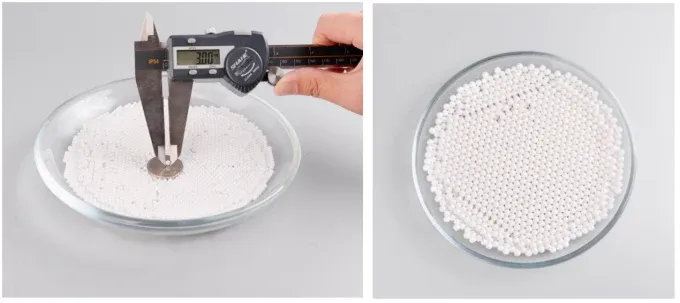
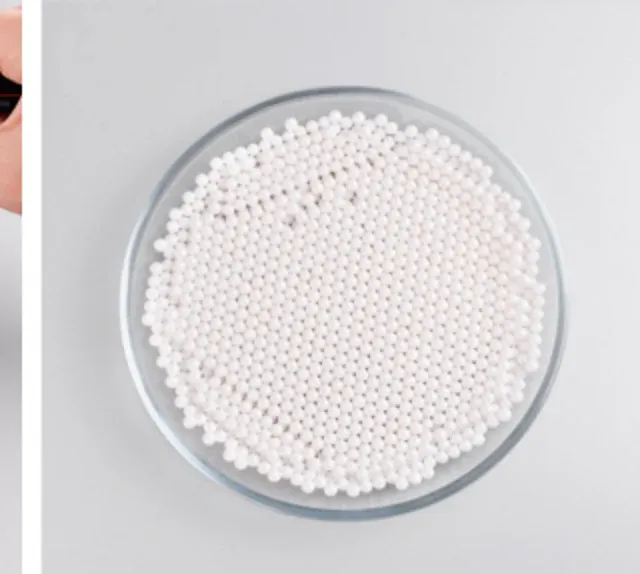
Micro zirconia beads in 0.1 mm and 0.3 mm grades (D50 ≈103.2 µm and ≈300.1 µm) for nano grinding and fine dispersion in stirred mills. Y-TZP, 94.6% ZrO2, density ≥6.03 g/cm³, sphericity ≥98%, packed in 25 kg drums.
Specifications
- ZrO2 Content
- 94.6%
- Stabilizer
- Y2O3 (5.4% with others)
- True Density
- ≥6.03 g/cm³
- Bulk Density
- ≥3.76 g/cm³
- Mohs Hardness
- 9
- Vickers Hardness
- ≥1210
- Fracture Toughness
- 9 MPa·m1/2
- Grain Size
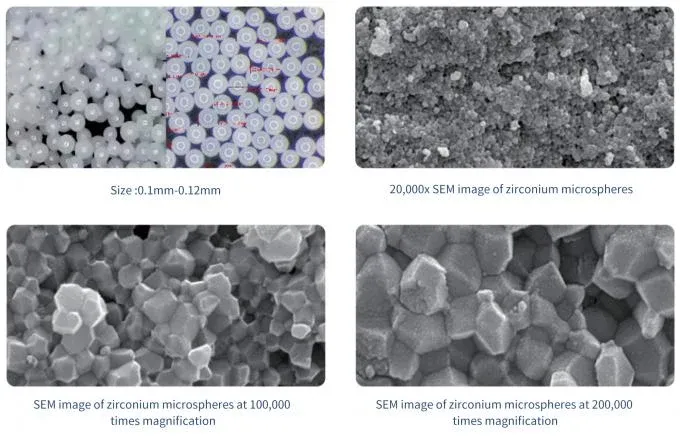
- ≤0.3 µm
- Sphericity
- ≥98%
- Grades
- 0.1 mm (D50 ≈ 103.2 µm); 0.3 mm (D50 ≈ 300.1 µm)
- Sintering Temperature
- ≥1500 °C
- Packaging
- 25 kg plastic drum; 800–1000 kg per pallet
Fine beads for the last micron
Most grinding jobs fail at the end, not the beginning. Breaking coarse feed is easy work for almost any media; reaching a stable sub-micron finish, batch after batch, is where the media charge earns its money. These micro zirconia beads are made for that final stage: fine grinding and dispersion in stirred mills and high-energy equipment, where the target is measured in hundreds of nanometres and the tolerance is not.
The beads are yttria-stabilized zirconia (Y-TZP) with 94.6% ZrO2, true density of at least 6.03 g/cm³ and sphericity of at least 98%. Two micro grades anchor the range: 0.1 mm with a D50 of about 103.2 µm, and 0.3 mm with a D50 of about 300.1 µm.
Why bead size consistency decides dispersion quality
A dispersion is only as uniform as the smallest gaps in the media bed. When beads are tightly graded, the shear zones between them are consistent, so every agglomerate sees similar treatment and the particle size distribution narrows instead of smearing. When the charge mixes sizes, fine particles hide in the voids between large beads and coarse particles are polished instead of broken.
That is why the grade figures above are D50 values, not marketing diameters. A 0.1 mm grade centred at about 103.2 µm behaves like a single tool. For nano grinding of pigments, ceramic inks, battery slurries and electronic pastes, that consistency is the difference between a dispersion that passes on the first check and one that goes back into the mill.
Density does the work that speed cannot
In a stirred mill, raising agitator speed has limits: heat, wear and foaming all arrive before the fineness does. Dense media attacks the problem from the other side. At 6.03 g/cm³ or above, each zirconia bead carries far more energy into every contact than glass or lower-density ceramic beads, so agglomerates break at moderate speeds and the process stays controllable.
The fine grain structure — 0.3 µm or below — and Mohs hardness 9 keep that performance stable over long runs. Beads that wear unevenly change size as they work, and the dispersion drifts with them. These beads hold their grade, so the tenth batch behaves like the first.
Low contamination at the finest sizes
The finer the grind, the larger the media surface area in contact with your product, and the more media wear matters. Zirconia is chemically stable against strong acids, alkalis and solvents and adds no metallic contamination, which is why micro zirconia beads are specified for nano-scale powders, biological materials, cosmetics and high-purity ceramic and battery materials.
Choosing between 0.1 mm and 0.3 mm
Start from the feed. If your pre-dispersion already sits in the low microns and the target is sub-micron, the 0.1 mm grade gives the contact density you need. If the feed is coarser or the slurry is viscous, the 0.3 mm grade survives the energy involved and still finishes fine. Many plants run the two in sequence rather than forcing one grade to do both jobs.
Tell us your mill, your feed size and your target D50, and we will recommend the grade and charge for your process. Standard packaging is 25 kg plastic drums, 800–1000 kg per pallet.