Grinding Guides
Why Grinding Media Density Matters for Battery and Ceramic Powders
Density sets the energy in every media impact. For battery and ceramic powders, it decides milling time, throughput and how much energy each kilogram costs.
The specification hiding in plain sight
Grinding media quotations lead with size and price. Density sits further down the datasheet, in grams per cubic centimetre, looking like a material property rather than a process decision. It is the most consequential number on the page. Density decides how much energy each ball or bead delivers at every contact, and from that single fact flow your milling time, your throughput, your energy bill and — in battery and ceramic production — part of your product quality.
This article explains the mechanism in plain terms, then works through what it means in the two industries where the stakes are highest: lithium battery materials, where grinding sits directly in front of cell performance, and ceramics, where powder preparation decides what the kiln can and cannot forgive.
Energy per impact is mass times motion
A grinding mill moves media; the media does the work. The kinetic energy in a moving ball rises with its mass and with the square of its speed. Mills have practical speed limits — heat, wear, vibration and safety all push back — so once a machine is running at its sensible speed, the remaining lever on impact energy is the mass of each piece of media. And mass, at a fixed ball size, is density.
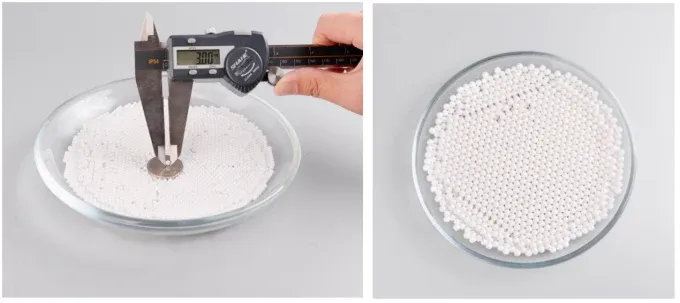
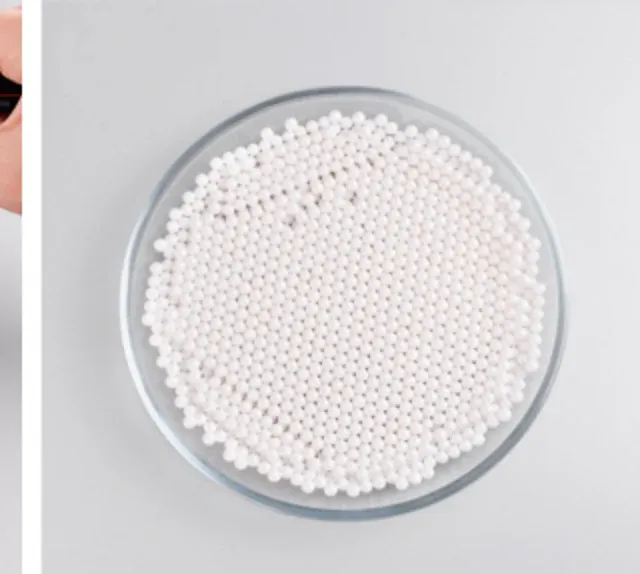
Compare the common ceramic media at the same diameter. Alumina balls sit at roughly 3.6 to 3.9 g/cm³. Yttria-stabilized zirconia sits at 6.03 g/cm³ or above — our material is at least 6.03 g/cm³ true density, with bulk density of at least 3.76 g/cm³. At equal size and speed, each zirconia impact carries roughly half again the energy of an alumina impact. Multiplied by millions of contacts per hour, that difference is the difference between a batch that finishes inside the shift and one that finishes tomorrow.
There is a second, quieter effect. Denser media settles and flows differently in a slurry: it stays where the energy is, in the active zone of the mill, instead of being carried around by the liquid. In wet grinding and dispersion, high-density media keeps working in viscous slurries that would float lighter media into useless circulation.
Battery materials: where density meets electrochemistry
Cathode and anode production grinds and disperses powders whose particle size distribution shows up later as coating quality, electrode density and cell consistency. The grinding step is asked to do two things at once: reach a tight, repeatable fineness, and add nothing to the chemistry. Iron pickup is the classic failure — metallic contamination that can seed defects no formation cycle will cure.
Density serves the first demand. High-energy impacts from dense zirconia media break hard cathode particles and disperse agglomerates in fewer passes, which shortens the exposure of the material to the process and narrows the spread between the first and last material through the mill. Shorter, more uniform treatment is what a tight distribution actually is.
Zirconia's material nature serves the second demand. It is a ceramic, chemically stable, with no metallic content to shed; at Mohs hardness 9 and fracture toughness of 9 MPa·m1/2 it also wears slowly, so what little media loss occurs over a campaign stays small and stays ceramic. For precursor, cathode, anode and solid-electrolyte work, that combination — more energy per impact, no iron in the product — is why dense zirconia media became the default specification rather than an upgrade.
The sizing follows the process stage. Coarser zirconia balls handle the early size reduction; micro beads of 0.1 mm and 0.3 mm, with D50 values around 103.2 µm and 300.1 µm, do the final dispersion work in stirred mills where contact density decides the finish.
Ceramics: the kiln forgives nothing upstream
Ceramic bodies, glazes and electronic ceramics all begin as milled powders or slips, and every inconsistency in that powder reappears after firing as warping, pinholes, strength variation or colour drift. The mill's job is not merely fineness but sameness — the same distribution this month as last.
Dense media helps twice here. In body and glaze preparation, higher impact energy shortens long wet-milling cycles, which reduces the slow drift that creeps into a process measured in tens of hours. In electronic ceramics, where powders are ground fine and purity is specified tightly, zirconia's combination of density and chemical stability gives sub-micron results without the metallic or low-grade ceramic contamination that changes dielectric behaviour.
There is also an economic point specific to ceramics: media consumption per tonne. A harder, denser medium that wears slowly — fine grain structure of 0.3 µm or below, sphericity of at least 98% so the charge rolls instead of gouging — can cost more per kilogram and less per tonne of finished powder, because the charge lasts longer and the mill spends its hours grinding product rather than compensating for tired media.
The arithmetic your finance team will ask for
Density discussions end, sooner or later, in a cost meeting, so it is worth doing the simple sum in advance. Media is bought by the kilogram, and zirconia costs more per kilogram than alumina. But the charge is bought once and consumed slowly, while the mill's hours are bought every day. If a denser charge cuts a six-hour cycle to four, the saving is two hours of motor energy, cooling, labour attention and — usually the largest figure — two hours of capacity on a machine that other batches are queuing for. Across a year of production, that capacity figure routinely outweighs the price difference of the charge itself, before media life is even counted. When you present the comparison, present cost per finished tonne, not cost per kilogram of balls.
When density is not the answer
Honesty about limits makes the rest of this guide worth trusting. Very dense media in a fragile jar is a mistake: a high-energy charge in a light jar on a gentle mill can wear the jar faster than the product. Soft, sticky materials sometimes disperse better with lower-energy, high-shear treatment than with heavier impacts. And in a stirred mill run at the top of its speed range, raising media density raises the load on agitator and seals; the machine must be specified for the charge it will carry.
Density is a lever, not a religion. The correct specification is the densest media your mill, jar and material can use productively — which for most battery and ceramic duties is zirconia, and for some gentle mixing duties may not be.
Reading a datasheet for density
Two numbers get quoted, and they are not interchangeable. True density describes the material itself; bulk density describes a poured charge, voids included. Our zirconia is specified at ≥6.03 g/cm³ true and ≥3.76 g/cm³ bulk. When comparing suppliers, compare the same figure, and treat a datasheet that quotes one number without naming it as a question to ask, not a specification to file.
Pair density with the wear figures before deciding. A dense medium that chips is a contamination source with good marketing. Hardness, toughness and grain size are the numbers that tell you whether the density will still be working for you in six months.
The short version
Density is energy per impact, and energy per impact is milling time, throughput and cost per kilogram. Battery production buys it for fineness without iron; ceramics buy it for uniformity that survives the kiln. If your current media makes the mill the bottleneck of the line, the datasheet number to change first is the one measured in g/cm³.
Send us your material, mill type and target size, and we will work out the media density, size and charge your process actually needs.