Grinding Guides
How to Choose Zirconia Grinding Media: Size, Density and Contamination
Media size, density and wear decide your fineness, purity and cost per batch. A practical guide to choosing zirconia grinding balls for labs and production plants.
The media is a process decision, not a purchase line
Ask a milling operator what decides whether a batch hits its particle size target, and the mill itself is only part of the answer. The grinding media — the balls or beads doing the work inside the jar or chamber — decides how much energy reaches the powder, how fast the powder gets there, and what else ends up in the powder along the way. Choose the media as an afterthought, and the symptoms are familiar: milling times that drift from batch to batch, fineness that will not repeat, and contamination that nobody can trace.
Zirconia grinding media is the default answer for a growing list of applications, from battery materials to electronic ceramics. But "zirconia" on a quotation is not a specification. Two zirconia balls can differ in density, hardness, size consistency and wear behaviour, and those differences are exactly what you are paying for. This guide walks through the three decisions that matter — size, density and contamination — and the checks to run before you commit to a media charge.
Decision one: size follows the feed and the target
Media size is the most visible choice, and the one most often made by habit. The working rule is simple: the media must be large enough to break your feed particles, and small enough to reach your target fineness efficiently.
Large balls carry more energy per impact. They are the right tool for coarse feed and hard materials, where each collision has to do real fracture work. But a charge of only large balls leaves large voids between contact points, so fine particles slip through unground and the last part of the grind — the part that decides your D50 — goes slowly.
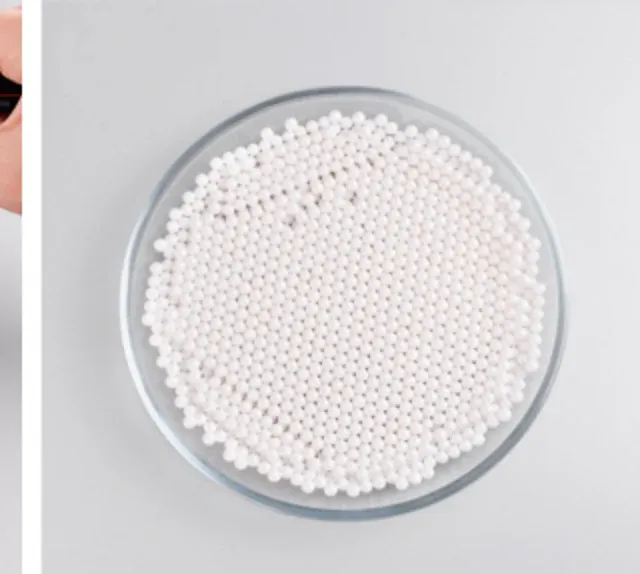
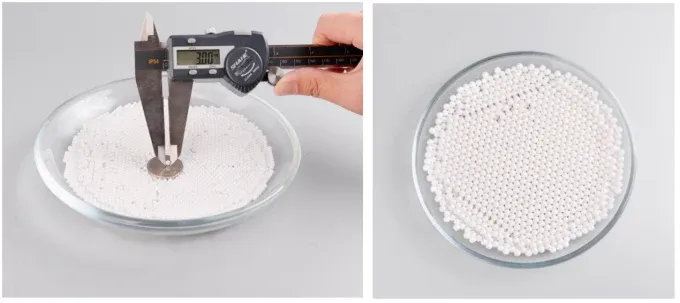
Small beads invert the trade. A 0.1 mm or 0.3 mm bead charge has far more contact points per litre, which is what fine and nano grinding needs. Our 0.1 mm grade, for example, has a D50 of about 103.2 µm, and the 0.3 mm grade about 300.1 µm, so the charge behaves uniformly instead of as a mix of sizes. The limit is energy per impact: beads that are too small for your feed will polish it rather than break it, and milling time stretches out.
In practice, start from the target, not the feed. If your specification is a sub-micron dispersion for a coating or a cathode powder, plan the final stage around fine beads and accept that a coarser first stage may do the heavy work. If you run one mill and one charge, tell your supplier both numbers — feed size and target size — because the right single charge is a compromise between the two, and it should be a deliberate one.
One more size point buyers miss: consistency inside the charge. A nominal 1 mm media that actually spans 0.7 to 1.4 mm behaves like several charges mixed together. The fine fraction over-grinds, the coarse fraction under-grinds, and your particle size distribution widens. Ask how the size is graded, and check the D50 of the grade you are buying, not just the headline diameter.
Decision two: density is grinding energy
Density is the specification that separates zirconia from cheaper ceramic media, and it works through plain physics. Kinetic energy rises with mass, and at the same mill speed a denser ball arrives at the powder with more of it. Yttria-stabilized zirconia has a true density of at least 6.03 g/cm³ — roughly half again as dense as alumina media — so each impact does more work and the batch reaches fineness faster.
That speed is money in two places. First, mill hours: shorter cycles mean more batches per week from the same equipment, or the same output from a smaller mill. Second, energy per kilogram: a mill that finishes in three hours instead of five has not just saved time, it has saved two hours of motor, cooling and operator attention on every batch.
Density also interacts with your mill type. In high-energy equipment such as stirred mills, dense media uses the machine's energy well and is usually the correct default. In gentler equipment, very dense media can increase wear on jars and liners if the charge is run too aggressively, which is one reason media, jar and mill should be specified together rather than bought from three unrelated listings.
Check the number on the datasheet, and check which number it is. True density and bulk density are different figures — our zirconia balls, for instance, are at least 6.03 g/cm³ true density and at least 3.76 g/cm³ bulk density. A supplier quoting only the higher figure without saying which one it is has told you less than you need.
Decision three: contamination and wear are the same problem
Every media wears. The question is how fast, and where the worn material goes. It goes into your product. For a structural ceramic, a fraction of a percent of media wear may be acceptable. For a lithium battery material, iron or other metallic pickup can be a reject-level defect. For a cosmetic or biological material, the contamination question is a regulatory one, not just a quality one.
This is where hardness and toughness earn their price. Zirconia at Mohs hardness 9, with Vickers hardness above 1210 and fracture toughness of 9 MPa·m1/2, resists both abrasive wear and chipping. Chipping matters as much as surface wear: a chipped ball sheds fragments, changes the size distribution of the charge, and can damage jar walls. A fine grain structure — 0.3 µm or below in our material — is part of the same story, because fine, uniform grains wear evenly instead of pulling out in patches.
Chemical stability is the third leg. Zirconia media stands up to strong acids, alkalis and solvents, so the same charge family can serve a water-based ceramic slip, a solvent-based coating and an aggressive chemical process without the media becoming the weak point.
Translate this into buying questions. What is the wear behaviour in a process like yours? What does the media contribute to the product at your milling time and energy? If a supplier cannot discuss contamination in numbers or in comparable applications, the low price on the quotation is carrying a risk that will surface in your quality data, not in their invoice.
Putting it together: a short selection checklist
Before you order a zirconia media charge, have five things written down. First, your feed particle size and the hardest component in it. Second, your target size — D50 alone, or the full distribution your customer specifies. Third, your mill type and working volume, because charge ratio and media size are set against the machine. Fourth, your contamination limits, stated as what must not appear in the product. Fifth, wet or dry process, and the chemistry involved.
With those five, a competent supplier can recommend a size, a grade and a charge ratio, and explain the reasoning. Without them, you are buying a diameter and a price, and the process will teach you the rest at production cost.
Where to start
If you are replacing an existing charge, start with what is in the mill now: its material, size and how it failed — slow grinding, wide distribution, contamination, or short life. Each failure points at a different fix, and only one of them is "buy the same again." If you are specifying a new line, start from the target fineness and contamination limit and work backwards.
Send us your material, mill type, target particle size and current media, and we will recommend a zirconia size and grade for your process — including when the honest answer is a smaller trial quantity before a full charge.