Grinding Guides
Planetary vs Stirred Ball Mills: Which Fits Your Lab or Plant?
Planetary and stirred mills both grind fine, but they scale, cost and behave differently. How to choose by batch size, fineness target and production plans.
Two machines that both promise fine powder
Put a planetary ball mill and a stirred ball mill side by side in a catalogue and they seem to compete: both grind to the micron and below, both take ceramic media, both serve the same industries. Buyers are then left comparing top speeds and prices, which is how laboratories end up with production machines they cannot fill and plants end up with benchtop machines running around the clock.
The two designs are not rivals. They are answers to different questions, and the right choice falls out of three facts about your work: how much material you grind, how fine it must be, and whether the process stops at research or continues into production. This guide works through each in turn.
How the energy gets into the powder
A planetary mill works in jars. The jars sit on a rotating disc, revolving around the main axis while spinning on their own axes in the opposite direction. The combined motion throws the grinding media across the jar with high impact energy, and the sample is crushed between media, wall and media again. It is the highest energy density available in a laboratory-scale batch machine, which is why planetary mills handle hard, brittle materials and mechanical alloying that gentler machines cannot touch.
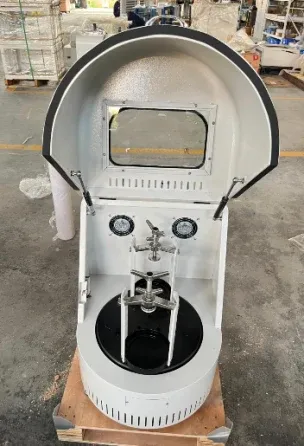
A stirred mill works in a stationary chamber. An agitator — a shaft with discs or pins — drives a charge of small beads through the slurry. The energy arrives as continuous shear and impact distributed through the whole chamber volume. No single collision matches a planetary jar at full speed, but the stirred design applies its energy to far more material at once, and it keeps applying it uniformly for as long as the batch runs.
Everything else in this comparison follows from those two mechanisms: batch jars versus a working chamber, impact bursts versus continuous shear.
Batch size is the first filter
Planetary mills are batch machines with laboratory hearts. Jar volumes run from a few millilitres to a few litres — our XQM series spans 1 ml to 5000 ml of jar volume — and a run produces grams to a few kilograms of finished powder. For research samples, quality-control preparation and high-value materials, that is exactly the right scale. For a production target measured in tonnes, it is not, and no amount of parallel jars turns a laboratory machine into a plant.
Stirred mills scale in the other direction. Our ZLS series starts at 1L for formulation work and runs to 600L industrial chambers carrying around 200L of material per batch, in batch or continuous operation. If your process will ever be specified in kilograms per hour rather than grams per experiment, the stirred design is the one that can grow with it.
The honest middle case is pilot work. A laboratory stirred mill of a few litres behaves like its industrial relatives — same principle, same media logic — so results transfer. A large planetary mill does not transfer to anything; it is the end of its own line. Choose by where the process is going, not only by where it is today.
Fineness: both arrive, by different roads
Both designs reach sub-micron territory. Planetary mills get there through impact intensity: high rotational speeds, up to 800 rpm on our representative XQM model, with dense media, and final fineness below 1 µm. They are especially strong on dry grinding and on hard materials where fracture energy is the limiting factor.
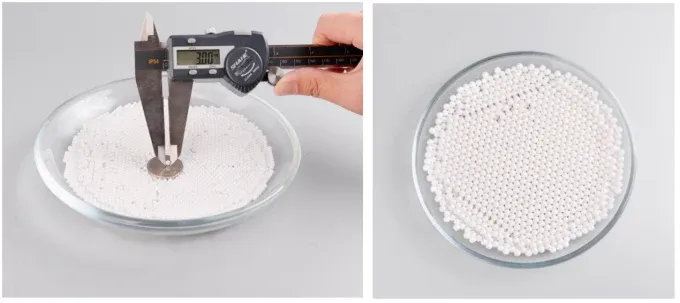
Stirred mills get there through contact frequency. A chamber full of fine beads — 0.1 mm to 0.3 mm zirconia micro beads are typical for the finest work — presents millions of contact points, and the discharge reaches 1 µm and below with a narrow distribution. They are especially strong in wet grinding and dispersion, where the product is a slurry or paste rather than a dry powder: coatings, ceramic inks, battery slurries and pigments are stirred-mill home ground.
A useful rule: if the deliverable is a dry powder sample, think planetary first; if the deliverable is a liquid dispersion at volume, think stirred first. Then check the exceptions against your material.
Contamination and the jar question
In a planetary mill, the grinding system is the jar plus its media, and both are chosen per job: zirconia jars and balls for low-contamination high-energy work, agate for analytical purity, tungsten carbide for extreme hardness, steel for general duty. Changing the process chemistry can be as simple as changing the jar set.
In a stirred mill, the chamber lining and the bead charge play the same role — stainless, polyurethane or ceramic-lined chambers, zirconia beads where purity matters — but they are capital choices, changed rarely and cleaned carefully between campaigns. Cross-contamination control in a stirred plant is a cleaning procedure; in a planetary lab it is a jar swap. For multi-product research environments, that difference is worth real money.
Cost shape: capital, energy and attention
Planetary mills are compact, comparatively inexpensive, and economical in attention: load jars, set the digital program of time, speed and pause cycles, and walk away. Their cost per kilogram is high, but at laboratory volumes nobody should be counting cost per kilogram.
Stirred mills invert the shape: serious capital at production sizes, motors up to 22 kW on the largest ZLS model, and real process attention — media charge, flow, temperature. Their cost per kilogram, however, is what production is made of, and the energy goes into a chamber full of product instead of a jar of samples.
Maintenance follows the same split. A planetary mill asks for jars, media and occasional drive service. A stirred mill asks for agitator and seal care, media top-ups and cleaning — a maintenance routine, budgeted like any other production asset.
And where the roller mill fits in this
A comparison of two designs should not pretend they are the whole catalogue. The roller, or jar, mill takes the third position: jars resting on driven rollers, turning steadily for long, gentle runs. It offers neither the planetary mill's impact energy nor the stirred mill's throughput, and for a large class of work — glaze and pigment preparation, powder blending, long uniform grinding where hours are cheap and uniformity is everything — it does not need to. When a buyer's real process is patient rather than intense, the simplest machine is the correct answer, and any honest comparison should say so before the decision path below begins.
A short decision path
Ask four questions in order. How much finished material per day — grams, kilograms or tonnes? Is the product a dry powder or a wet dispersion? Is this the final scale, or a step toward production? And how many different materials must the machine serve?
Grams, dry, final scale, many materials: planetary. Kilograms moving toward tonnes, wet, production-bound, one main product family: stirred. Kilograms, dry, still developing: a large planetary or a laboratory stirred unit, decided by whether the process will scale further.
Start from your process, not the catalogue
Send us your material, batch size today, target fineness and where the process goes next. We will recommend the design that fits — planetary, stirred, or the laboratory version of the one you will eventually scale — with jars, chamber and media specified as one system.